

This blog is devoted to the study and discussion of Yu-Gi-Oh! Trading Card Game (TCG) rulings, tournament policy, and the Yu-Gi-Oh! TCG judge system.
Its primary subject is how Yu-Gi-Oh! TCG rules and card interactions are interpreted and resolved, both during sanctioned tournaments and within the wider organized-play structure. This includes card rulings, tournament procedures, judge decisions, policy documents, and the ways in which rulings and rules are communicated to players and judges.
Particular attention is given to questions of authority, consistency, documentation, interpretation, and accessibility. How should a judge resolve an unclear card interaction? What makes a ruling authoritative? What is the relationship between written rules, tournament policy, established practice, and individual judge decisions? These questions are central to understanding the Yu-Gi-Oh! TCG ruling system.
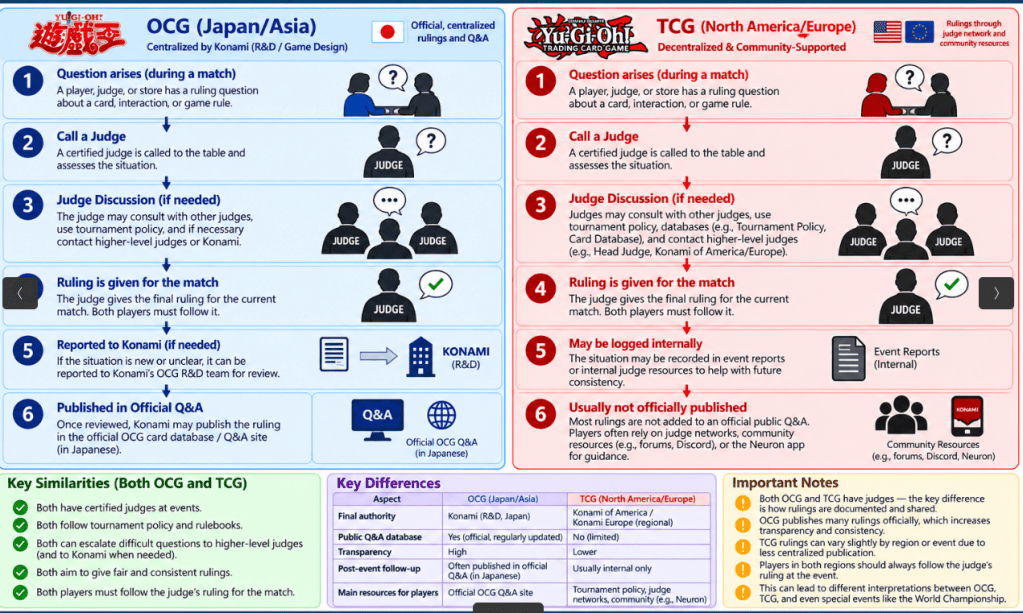
Where appropriate, the blog will also examine the relationship between TCG and OCG rulings. The two environments share the same underlying game but operate within different organized-play structures and approaches to rules documentation. Comparing the TCG and OCG can therefore provide useful insight into how different ruling systems function.
The discussion will also incorporate a philosophical and jurisprudential perspective. Rules in a trading card game are not merely technical instructions; they form a system of norms that must be interpreted and applied by people and institutions. Questions concerning the nature of rules, the authority of judges, the relationship between written rules and established practice, and the distinction between a rule and a convention have important parallels in the philosophy of law and the study of legal and social norms.
The purpose is not to argue that Yu-Gi-Oh! constitutes a legal system in the strict sense. Rather, concepts from jurisprudence, legal philosophy, and the study of norms can provide useful analytical tools for examining how the TCG’s rules are created, interpreted, applied, and understood.
This blog is not affiliated with or operated by Konami, its regional tournament organizers, or any official Yu-Gi-Oh! judging organization. The content is intended for analysis, research, and discussion. It does not replace an official Konami ruling, tournament policy, or a ruling issued by a Head Judge at an event.
The focus throughout is the Yu-Gi-Oh! TCG ruling and judge system: how rules are interpreted, how judges make decisions, how tournament policies operate, and how a rules-based competitive game develops and maintains its own system of norms.
The blog does not primarily cover Yu-Gi-Oh! strategy, deck construction, card collecting, product news, or general game news. Its subject is narrower: Yu-Gi-Oh! TCG rules, rulings, judges, tournament policy, and the philosophy of rules and norms.
Archive public TCG rulings and make them public .
Given the current situation (2026), see image, there is the need to at least start archiving public made rulings. I will discuss in an essay the limitations and related topics. However, for now, the most important part is that this blog will archive rulings made on Reddit. You might ask the following question: why post it here if it is already on Reddit . To which the answer is:
1: A Reddit account and posts can be deleted.
2: the ruling given on Reddit often needs to be more streamlined (better overview)
I will perceive Reddit rulings as customary law:
- Repeated consistently over time
- Generally accepted by the relevant community
- Followed because people believe it is obligatory, not merely convenient
- Sometimes recognized or enforced by an authority/court
However, this is not on the legal level as official Konami communicated rules and regulations. Regarding this, the OCG is in a far superior position when compared to the TCG.
Future plans
In the future I am planning to release a software that will help giving more clarity. Moreover, the TCG should aim to follow the OCG path.


Leave a Reply