Authority: Duelpedia
Official ruling confirmed: unknown
Source: Duelpedia
Link: https://duelpedia.com/2026/09/24/yu-gi-oh-levels-ranks-and-link-ratings-explained/
Format: TCG
Status: resolved
Date: 24 September 2026
One of the first confusing things new Yu-Gi-Oh! players encounter is that monsters can display numbers that look similar but mean completely different things.
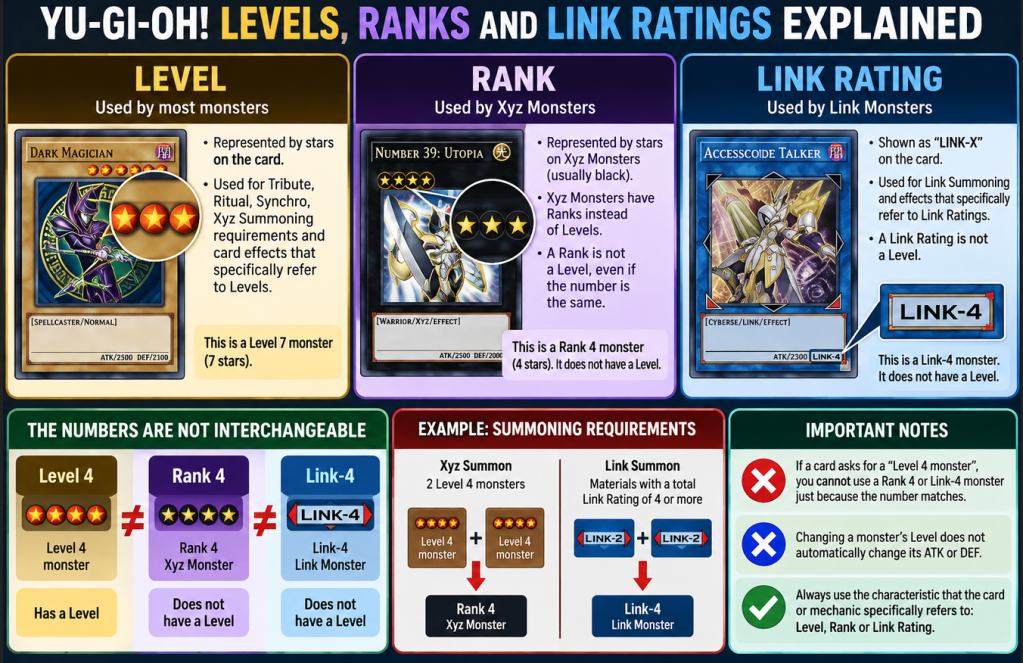
A monster might be Level 4, Rank 4, or Link-4.
These are not three different ways of saying the same thing.
Levels, Ranks, and Link Ratings are separate game characteristics, and card effects that refer to one do not automatically refer to the others. The official rulebook explicitly states that Xyz Monsters have Ranks instead of Levels. (Yu-Gi-Oh! Card Database)
Understanding this distinction prevents a surprising number of ruling mistakes.
1. What Is a Level?
A monster’s Level is represented by the stars near the top of most Monster Cards.
For example:
Level 4 = ★★★★
The official rulebook explains that you determine a monster’s Level by counting these stars. (Yu-Gi-Oh! Card Database)
Levels are used by many different cards and Summoning mechanics.
They are particularly important for:
- Tribute Summoning
- Ritual Summoning
- Synchro Summoning
- Xyz Summoning requirements
- Card effects that specifically refer to Levels
For example, a Synchro Monster might require:
1 Tuner + 1+ non-Tuner monsters
The Levels of the monsters used normally need to add up to the Level of the Synchro Monster being Summoned.
Likewise, a typical Rank 4 Xyz Monster might require:
2 Level 4 monsters
The official rulebook uses Number 39: Utopia as an example of an Xyz Monster Summoned using two Level 4 monsters. (Yu-Gi-Oh! Card Database)
2. What Is a Rank?
Xyz Monsters do not have Levels.
They have Ranks.
The official rulebook states this directly: Xyz Monsters have Ranks instead of Levels. (Yu-Gi-Oh! Card Database)
This means:
Rank 4 ≠ Level 4
Even though both contain the number 4, they represent different characteristics.
A Rank 4 Xyz Monster is therefore not a Level 4 monster.
This distinction becomes important whenever an effect specifically asks for a monster with a particular Level.
For example, suppose an effect says:
Target 1 Level 4 monster you control.
You cannot automatically choose a Rank 4 Xyz Monster simply because its Rank is 4.
The effect specifically asks for a Level.
3. What Is a Link Rating?
Link Monsters introduce another characteristic: the Link Rating.
Instead of having a Level or Rank, a Link Monster has a Link Rating such as:
LINK-1
LINK-2
LINK-3
LINK-4
The Link Rating is used by Link mechanics and by effects that specifically reference Link Ratings. Official card text in Konami’s database, for example, separately refers to a monster’s Link Rating when an effect needs that value. (Yu-Gi-Oh! Card Database)
A Link Rating is not a Level.
Therefore:
Link-2 ≠ Level 2
and:
Link-4 ≠ Level 4
A Link Monster does not acquire a Level simply because its Link Rating has a numerical value.
4. Level vs Rank vs Link Rating
The easiest way to remember the distinction is:
| Characteristic | Used By | Example |
|---|---|---|
| Level | Monsters that have Levels | Level 4 |
| Rank | Xyz Monsters | Rank 4 |
| Link Rating | Link Monsters | Link-4 |
The numbers may look similar, but they are not interchangeable.
Therefore:
Level 4 ≠ Rank 4 ≠ Link-4
This distinction matters whenever card text specifically names one of these characteristics.
5. Can a Rank Be Used as a Level?
Normally, no.
If an effect specifically asks for the Level of a monster, you cannot simply substitute an Xyz Monster’s Rank.
For example:
Rank 8 Xyz Monster
does not mean:
Level 8 monster
The Xyz Monster has a Rank instead of a Level. (Yu-Gi-Oh! Card Database)
An individual card effect can, of course, create unusual interactions or explicitly tell players how to treat particular characteristics. When that happens, follow the card text.
But there is no general rule saying that Rank and Level are interchangeable.
6. Can a Link Rating Be Used as a Level?
The same principle applies to Link Monsters.
Suppose you control a Link-3 monster.
An effect asks you to interact with a:
Level 3 monster
The Link-3 monster does not qualify merely because both values happen to be 3.
Its Link Rating is 3.
It does not therefore have Level 3.
This distinction is particularly important for effects that calculate something using a monster’s Level.
7. Example: Rookie Fur Hire
Consider Rookie Fur Hire, whose effect refers to the Level of the monster Tributed to activate it and Special Summons a “Fur Hire” monster whose Level is 1 higher or 1 lower.
Suppose the monster involved is Link-2.
It may be tempting to calculate:
1 ← Link-2 → 3
as though Link-2 were Level 2.
That does not work.
A Link Rating is not a Level, so the number cannot simply be substituted into a calculation requiring the monster’s Level.
This is a useful example of why distinguishing the three characteristics matters in actual gameplay.
Related: Do Link Ratings Count as Levels for Rookie Fur Hire?
8. Does Changing a Monster’s Level Change Its ATK or DEF?
No — not by itself.
Level is also separate from ATK and DEF.
Suppose you have:
Level 4 / 1800 ATK / 1000 DEF
and an effect increases that monster’s Level by 4.
You now have:
Level 8 / 1800 ATK / 1000 DEF
The Level-changing effect does not inherently increase the monster’s ATK or DEF.
If another effect specifically connects a monster’s Level to its ATK or DEF, then that effect may cause the stats to change.
But simply increasing a monster’s Level does not make the monster stronger.
Related: Does Increasing a Monster’s Level Also Increase Its ATK or DEF?
9. Why Xyz Summoning Causes Confusion
Xyz Summoning is probably the easiest place to confuse Level and Rank.
Consider an Xyz Monster that requires:
2 Level 4 monsters
The materials are Level 4.
The resulting Xyz Monster might be Rank 4.
So the process looks like:
Level 4 + Level 4 → Rank 4 Xyz Monster
But this does not mean that the resulting monster remains Level 4.
The official rulebook’s Number 39: Utopia example demonstrates exactly this distinction: Level 4 monsters are used as materials to Summon a Rank 4 Xyz Monster. (Yu-Gi-Oh! Card Database)
10. Link Ratings Also Matter for Link Summoning
Link Ratings have their own role in Link Summoning.
They should therefore not be thought of as replacement Levels.
A Link Monster’s rating can matter when determining the requirements for another Link Summon, and individual card effects can also specifically reference total Link Rating.
Konami card text demonstrates this distinction explicitly by using terms such as “Link Rating” when that is the value the card cares about. (Yu-Gi-Oh! Card Database)
Again, the important principle is to use the characteristic that the game or card text actually specifies.
11. What Happens When a Card Specifically Says “Level”?
Read the word literally.
If the card says:
Level
look for a Level.
If it says:
Rank
look for a Rank.
If it says:
Link Rating
look for a Link Rating.
Do not convert one into another simply because the numbers happen to match.
A useful quick-reference table is:
| Card Text Refers To | Level 4 Monster | Rank 4 Xyz | Link-4 |
|---|---|---|---|
| Level 4 | Yes | No | No |
| Rank 4 | No | Yes | No |
| Link Rating 4 | No | No | Yes |
Individual card effects can create exceptions or special interactions, so always check the exact wording of the cards involved.
12. Common Misconceptions
“A Rank 4 Xyz Monster is basically Level 4.”
No. It is Rank 4. Xyz Monsters have Ranks instead of Levels. (Yu-Gi-Oh! Card Database)
“Link-3 means the monster is Level 3.”
No. The 3 represents its Link Rating.
“If an effect increases Level, ATK should increase too.”
Not automatically. Level and ATK are separate characteristics.
“All numbers printed on Monster Cards work the same way.”
No. Level, Rank, Link Rating, ATK and DEF represent different characteristics and values.
“If two characteristics have the same number, they can substitute for each other.”
Not as a general rule. The terminology used by the card or mechanic matters.
13. Quick Reference
When you’re unsure about an interaction, ask:
1. What does the card actually say?
Does it say Level, Rank, or Link Rating?
2. What characteristic does the monster actually have?
Do not substitute another characteristic merely because the number matches.
3. Is another card effect changing how the monster is treated?
If so, read that effect carefully.
The simplest rule to remember is:
Level, Rank and Link Rating are three different things.
14. Conclusion
Levels, Ranks and Link Ratings may all use numbers, but they serve different purposes in Yu-Gi-Oh!.
A Level 4 monster, Rank 4 Xyz Monster, and Link-4 Monster do not share the same characteristic simply because each displays the number 4.
Xyz Monsters have Ranks instead of Levels, while Link Monsters use Link Ratings. Card effects that specifically refer to a Level therefore do not automatically treat a Rank or Link Rating as that Level. The official rulebook explicitly establishes the Level/Rank distinction, while Konami’s card text separately identifies Link Rating when that characteristic is relevant. (Yu-Gi-Oh! Card Database)
Learning this distinction makes many other Yu-Gi-Oh! interactions considerably easier to understand, particularly when dealing with Xyz Summoning, Link Summoning, Level-changing effects, and cards that specifically reference monster Levels.
Official Sources
Official Yu-Gi-Oh! TCG Rulebook
Official Yu-Gi-Oh! Beginner’s Guide


Leave a Reply