Authority: Community discussion
Official ruling confirmed: unknown
Source: Reddit: r/Yugioh101
Link: https://www.reddit.com/r/Yugioh101/comments/13h43fk/how_does_chaining_work/
Format: TCG
Status: resolved
Date: 2023
Related: https://duelpedia.com/2026/09/20/can-you-pass-on-turn-player-priority-when-trigger-effects-activate/
Related: https://www.yugioh-card.com/en/play/fast-effect-timing/
1. Question
A player asked for an explanation of three closely related Yu-Gi-Oh! mechanics:
- How do Chains work?
- What players often call “chain blocking”?
- What is Spell Speed, and how does it determine which effects can respond to other effects?
The original question specifically wanted to understand why certain effects can or cannot be negated when several Trigger Effects activate at the same time.
2. Reddit Discussion
The Reddit discussion explained that activated effects can broadly be understood through Fast Effects, Trigger Effects, and Ignition-like Effects. Fast Effects include Quick Effects, Quick-Play Spells, and Trap Cards, while Trigger Effects activate when or if their specified event occurs.
Building a Chain
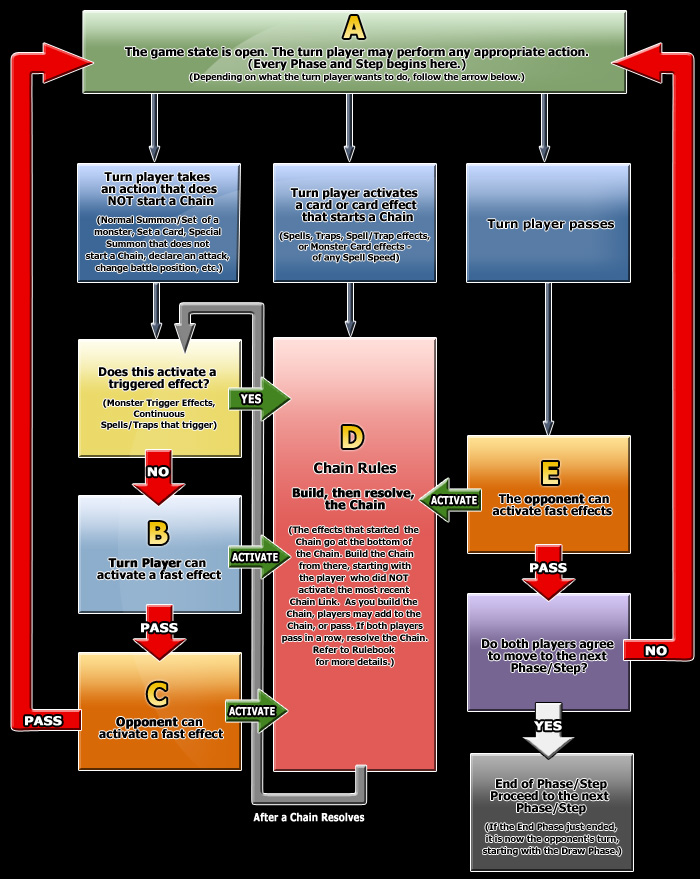
Once a Chain has started, the opponent of the player who activated the latest effect normally receives the next opportunity to activate an appropriate Fast Effect. If that player passes, the other player gets an opportunity. If both players decline to add anything further, the Chain begins resolving.
Chains resolve backwards: the most recently activated Chain Link resolves first, followed by the previous Chain Link, until Chain Link 1 resolves.
Importantly, players do not activate new cards or effects while a Chain is resolving.
For example:
Chain Link 1: Effect A
Chain Link 2: Effect B
Chain Link 3: Effect C
The Chain resolves:
CL3 → CL2 → CL1
Multiple Trigger Effects
The discussion also addressed situations where several Trigger Effects meet their activation conditions at the same time.
The explanation given was that these Trigger Effects are placed onto the Chain according to an ordering procedure. The Reddit answer summarized the order as:
- Turn player’s mandatory Trigger Effects
- Opponent’s mandatory Trigger Effects
- Turn player’s optional Trigger Effects
- Opponent’s optional Trigger Effects
Within the applicable group, the player determines the order of their effects.
This means that one player does not normally insert a Fast Effect between Trigger Effects while those Trigger Effects are being placed onto the initial Chain.
A later example in the discussion involved Lubellion, Tragedy, and Pinguicula. The player could activate Lubellion and Tragedy as CL1 and CL2, after which the opponent could activate Pinguicula as CL3. The opponent could not insert Pinguicula between those two Trigger Effects.
A commenter identified as a judge/moderator confirmed the same outcome.
What Is “Chain Blocking”?
The discussion cautioned against using the informal term “chain blocking.”
The situation usually described by that term occurs when multiple Trigger Effects are placed onto a Chain before players can begin adding Fast Effects.
Some response effects must activate directly in response to a particular effect. If another Trigger Effect occupies the next Chain Link, an effect requiring that direct response may no longer be able to respond to the earlier Chain Link.
The commenter therefore recommended describing the actual Chain structure rather than relying on the ambiguous phrase “chain blocking.”
3. Summary of the Reddit Answer
| Situation | Result |
|---|---|
| One effect activates and another legal Fast Effect responds. | The responding effect becomes the next Chain Link. |
| Both players decline to add another effect. | The Chain begins resolving. |
| A Chain contains CL1, CL2 and CL3. | It resolves CL3 → CL2 → CL1. |
| Several Trigger Effects meet their conditions at the same time. | They are placed onto the Chain according to Trigger Effect ordering. |
| One player has multiple applicable optional Trigger Effects. | They are placed onto the Chain before the opponent adds their applicable optional Trigger Effects. |
| An effect must respond directly to another activation. | It generally needs to occupy the immediately following Chain Link. |
| A different Trigger Effect becomes the next Chain Link. | A response requiring direct chaining to the earlier effect may no longer be possible. |
| Someone describes this as “chain blocking.” | The Reddit discussion recommends explaining the actual Chain and Trigger Effect ordering instead. |
4. Conclusion
The Reddit discussion explains that understanding Yu-Gi-Oh! Chains requires separating three concepts: when an effect can activate, how multiple Trigger Effects are ordered, and which effects can respond once the Chain has been constructed.
Once ordinary chaining begins, players receive opportunities to add appropriate Fast Effects. When both players decline, the Chain resolves backward from the highest Chain Link to CL1.
When multiple Trigger Effects activate from the same event, however, they are first placed onto the Chain according to their ordering rules. This is the situation players frequently call “chain blocking.” The Reddit discussion discourages that terminology because it can hide what is actually happening: an effect that must respond directly to another activation may be unable to do so because a different Trigger Effect occupies the immediately following Chain Link.
The discussion also points players toward Konami’s Fast Effect Timing flowchart and the official Rulebook for the underlying rules.
This article summarizes the Reddit discussion and should not be treated as a substitute for official Konami rules or policy.


Leave a Reply