
Authority: Duelpedia
Official ruling confirmed: unknown
Source: Duelpedia
Link: https://duelpedia.com/2026/09/23/yu-gi-oh-damage-step-explained/
Format: TCG
Status: resolved
Date: 23 September 2026
The Damage Step is one of the most restrictive parts of a Yu-Gi-Oh! TCG battle. A card may be perfectly legal during the Battle Step but impossible to activate moments later once the Duel enters the Damage Step.
This is intentional. Konami’s official rules place special restrictions on activations during this part of battle. Understanding those restrictions makes many seemingly strange card interactions much easier to explain. (Yu-Gi-Oh! Card)
1. What Is the Damage Step?
When a monster attacks, the battle does not immediately jump from attack declaration to comparing ATK and DEF.
The battle proceeds through the Battle Step and then the Damage Step. During the Damage Step, the attacked monster may be flipped face-up, ATK and DEF are compared, battle damage is inflicted, monsters are determined to be destroyed by battle, and battle-related effects can activate. (Yu-Gi-Oh! Card)
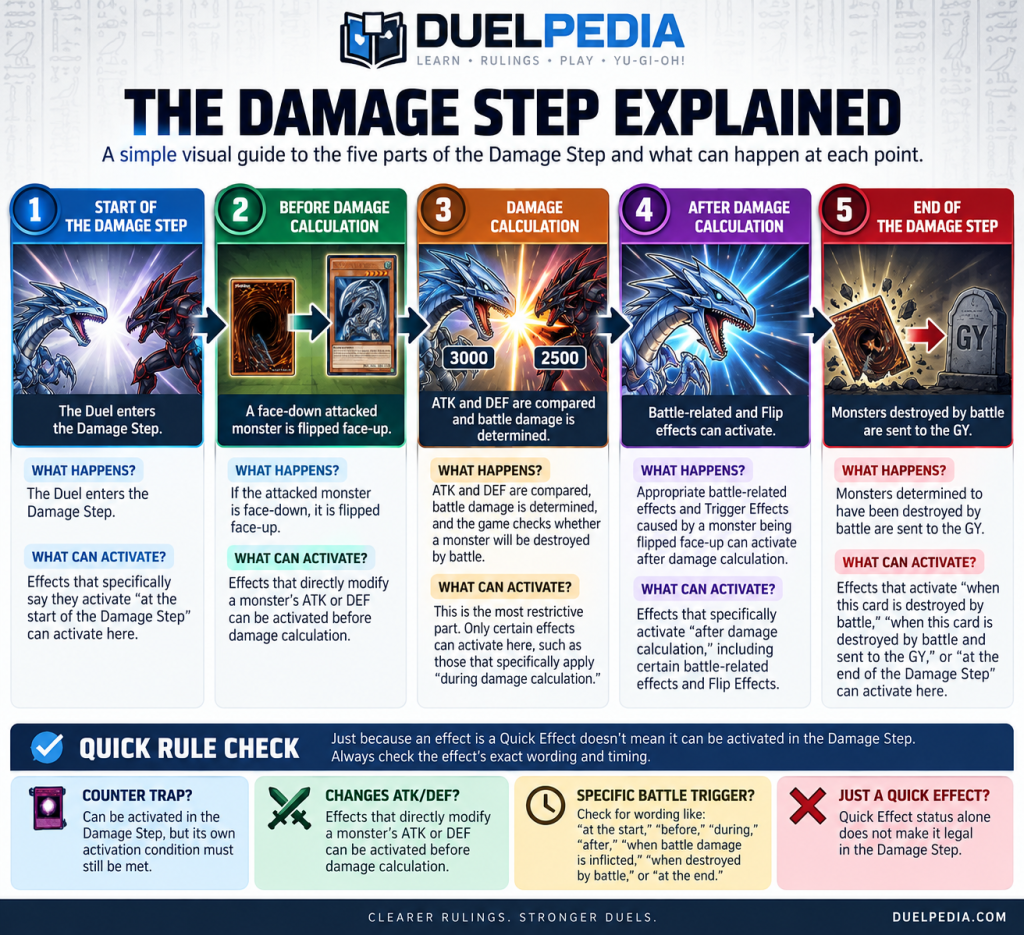
The official Damage Step breakdown can be simplified into five parts:
| Part | What happens |
|---|---|
| Start of the Damage Step | The Duel enters the Damage Step. |
| Before Damage Calculation | A face-down attacked monster is flipped face-up. |
| Damage Calculation | ATK/DEF are compared and battle damage is determined. |
| After Damage Calculation | Battle-related and Flip effects can occur. |
| End of the Damage Step | Monsters destroyed by battle are sent to the GY and appropriate effects can activate. |
These divisions matter because some effects specify exactly when they can activate. (Yu-Gi-Oh! Card)
2. Why Is the Damage Step Different?
The Damage Step restricts which cards and effects can be activated.
The basic official Rulebook gives a deliberately simple rule: during the Damage Step, activation is generally limited, with Counter Trap Cards and effects that directly modify a monster’s ATK or DEF specifically identified as cards that can be activated there. The Rulebook also notes that ATK/DEF-changing effects are limited to the appropriate portion before damage calculation. (Yu-Gi-Oh! Card)
However, this should not be interpreted as meaning that literally nothing else can ever activate during the Damage Step.
Many effects are designed to activate because something happens during battle—for example, an effect that activates when battle damage is inflicted or when a monster is destroyed by battle. Konami’s dedicated Damage Step rules explicitly identify several such activation points. (Yu-Gi-Oh! Card)
So the practical question is not simply:
“Is this effect a Quick Effect?”
Instead, ask:
“Is this type of effect allowed to activate at this particular point of the Damage Step?”
3. Effects That Specifically Activate During the Damage Step
The easiest category is card text that explicitly refers to an event or timing point occurring during battle.
Konami’s Damage Step guide identifies wording such as:
- “at the start of the Damage Step”
- “before damage calculation”
- “during damage calculation”
- “after damage calculation”
- “when battle damage is inflicted”
- “when you take damage”
- “when this card battles”
- “when this card is destroyed by battle”
- “when this card is destroyed by battle and sent to the GY”
- “at the end of the Damage Step”
These effects activate at the appropriate point indicated by their text. (Yu-Gi-Oh! Card)
This is why reading the exact activation condition is so important.
4. Effects That Change ATK or DEF
Effects that directly modify a monster’s ATK or DEF are an important Damage Step category.
For example, an effect might:
increase ATK, decrease ATK, increase DEF, decrease DEF, or otherwise directly change those values.
Konami’s official guide specifically states that after a face-down attacked monster is flipped face-up and before damage calculation, cards or effects that modify ATK/DEF can activate. (Yu-Gi-Oh! Card)
But there is an important timing restriction.
The official Rulebook states that these effects can only be activated up until the start of damage calculation. (Yu-Gi-Oh! Card)
So knowing that an effect modifies ATK or DEF is not enough—you must also determine which part of the Damage Step you have reached.
5. Counter Traps
Counter Trap Cards are another category specifically identified by the official Rulebook as being activatable during the Damage Step. (Yu-Gi-Oh! Card)
That does not mean every Counter Trap can automatically be activated whenever you want during the Damage Step.
Its own activation condition still has to be satisfied.
The Damage Step rules do not override the card’s text. They determine whether the type of activation is permitted at that point; the card must still have a legal reason to activate.
6. Flip Effects
Suppose you attack a face-down Defense Position monster.
Before damage calculation, that monster is flipped face-up so its DEF can be used for the battle.
But its Flip Effect does not immediately activate at that moment.
Konami’s Damage Step guide states that Trigger Effects caused by the monster being flipped face-up wait until after damage calculation. (Yu-Gi-Oh! Card)
This creates an important sequence:
Monster is flipped face-up → damage calculation occurs → Flip Effect activates afterward.
The official Rulebook additionally explains that if the Flip Effect needs to target a monster, it cannot target a monster that has already been determined to be destroyed during that damage calculation. (Yu-Gi-Oh! Card)
7. When Is a Monster Actually Sent to the Graveyard?
Another common source of confusion is assuming that a monster is immediately sent to the GY as soon as its ATK or DEF loses the battle.
That is not what happens.
During damage calculation, the game determines whether the monster will be destroyed by battle, but it is not sent to the GY yet.
After damage calculation, other appropriate effects can occur while the monster is still present.
At the End of the Damage Step, a monster determined to have been destroyed by battle is sent to the GY. Effects that activate because a monster was destroyed by battle and sent to the GY can then activate. (Yu-Gi-Oh! Card)
This distinction is important for many advanced rulings.
8. Can Any Quick Effect Be Activated During the Damage Step?
No.
Being a Quick Effect does not, by itself, give an effect permission to activate during the Damage Step.
This is one of the easiest mistakes for newer players to make.
Normally, Quick Effects have flexible activation timing. But the Damage Step introduces additional restrictions. You therefore need to check both:
1. Is the effect normally legal to activate at this time?
and
2. Is this type of activation permitted during this portion of the Damage Step?
An effect being Spell Speed 2 is not by itself enough to answer the second question. Konami’s Damage Step rules impose their own restrictions. (Yu-Gi-Oh! Card)
9. Damage Calculation Is Even More Restrictive
Another important distinction is between:
the Damage Step
and
damage calculation.
Damage calculation is only one portion of the Damage Step.
An effect being legal somewhere during the Damage Step does not automatically mean it can be activated during damage calculation.
Konami’s dedicated guide explicitly separates “Before Damage Calculation,” “Perform Damage Calculation,” and “After Damage Calculation” and identifies different effects that can occur at each point. (Yu-Gi-Oh! Card)
This is why the exact wording of a card can completely change a ruling.
10. A Practical Damage Step Checklist
When deciding whether a card or effect can be activated, ask these questions:
| Question | Why it matters |
|---|---|
| Are we actually in the Damage Step yet? | Battle Step and Damage Step follow different activation rules. |
| Which part of the Damage Step are we in? | Start, before calculation, calculation, after calculation and end are different timing points. |
| Does the effect specifically mention a relevant battle event? | Its text may explicitly establish when it activates. |
| Does it directly modify ATK/DEF? | This is an important permitted category before damage calculation. |
| Is it a Counter Trap? | Counter Traps are specifically recognized by the Rulebook. |
| Is it merely a generic Quick Effect? | Being a Quick Effect alone does not guarantee Damage Step legality. |
| Has damage calculation already started? | Some effects that were previously legal can no longer be activated. |
11. Common Misconceptions
“You cannot activate effects during the Damage Step.”
Incorrect. The Damage Step restricts activations, but many effects can still activate.
“Every Quick Effect works during the Damage Step.”
Incorrect. Quick Effect status alone is not sufficient.
“If an effect changes ATK, I can use it anywhere during the Damage Step.”
Incorrect. The official Rulebook places a timing restriction on this category. (Yu-Gi-Oh! Card)
“A Flip Effect activates as soon as the attacked monster is flipped.”
Not in this battle sequence. The monster is flipped before damage calculation, while its Flip Effect activates afterward. (Yu-Gi-Oh! Card)
“A monster destroyed by battle immediately goes to the Graveyard.”
Incorrect. Destruction is determined during damage calculation, while the monster is sent to the GY later, at the End of the Damage Step. (Yu-Gi-Oh! Card)
12. Conclusion
The most important lesson is that the Damage Step is not one single activation window.
It contains several distinct points:
Start of Damage Step → Before Damage Calculation → Damage Calculation → After Damage Calculation → End of Damage Step
Different effects become legal at different points.
Instead of asking only whether an effect is a Quick Effect or whether a Trap is Set, determine exactly where you are in the Damage Step and what kind of effect is being activated.
For difficult interactions, the exact card text still matters. A general Damage Step guide cannot determine every individual card interaction by itself.
Official Sources
This article is based primarily on Konami’s official Damage Step documentation and TCG Rulebook rather than community interpretation.
Official Konami Damage Step Rules
Official Yu-Gi-Oh! TCG Rulebook
This makes a good cornerstone Duelpedia article: your individual Damage Step rulings can link back to it, while this guide can link outward to those specific examples.


Leave a Reply