
Authority: Duelpedia
Official ruling confirmed: unknown
Source: Duelpedia
Link: https://duelpedia.com/2026/09/25/yu-gi-oh-once-per-turn-explained-soft-opt-vs-hard-opt/
Format: TCG
Status: resolved
Date: 25 September 2026
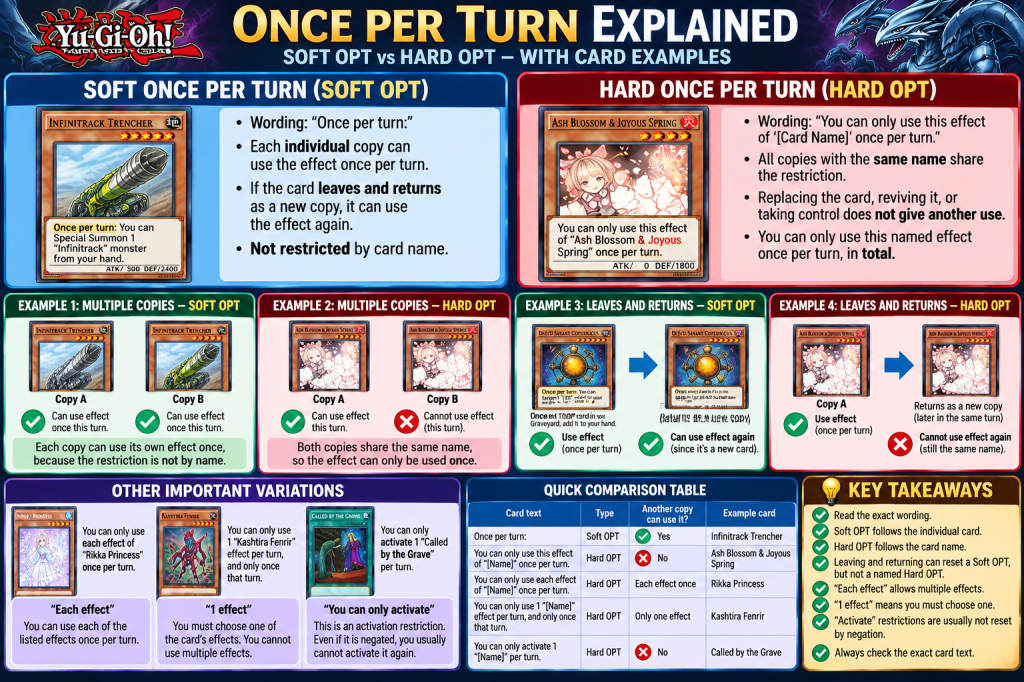
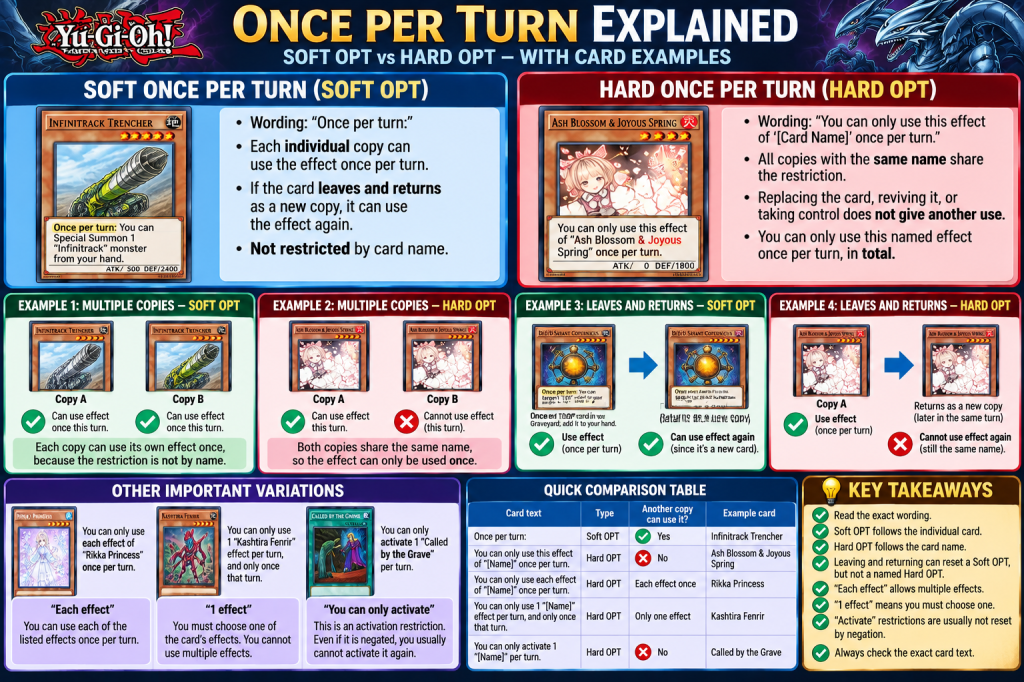
“Once per turn” looks like one of the simplest phrases in Yu-Gi-Oh!, but not every once-per-turn restriction works in exactly the same way.
Players commonly use the unofficial terms Soft Once Per Turn (Soft OPT) and Hard Once Per Turn (Hard OPT) to describe an important difference in card wording.
The key question is:
Is the restriction attached to that particular card, or does the card text restrict you by the card’s name?
Understanding that distinction explains why replacing, reviving, or taking control of a monster can sometimes allow an effect to be used again — and sometimes cannot.
1. What Does “Once Per Turn” Mean?
At its simplest, an effect might begin:
Once per turn:
This places a restriction on how often that effect can be used.
However, modern Yu-Gi-Oh! cards can instead use wording such as:
You can only use this effect of “[Card Name]” once per turn.
or:
You can only use each effect of “[Card Name]” once per turn.
These restrictions behave differently from a simple “Once per turn:” effect.
The community therefore commonly separates them into:
| Community Term | Typical Wording |
|---|---|
| Soft OPT | “Once per turn:” |
| Hard OPT | “You can only use this effect of ‘[Card Name]’ once per turn.” |
| Hard OPT — each effect | “You can only use each effect of ‘[Card Name]’ once per turn.” |
Soft OPT and Hard OPT are community shorthand rather than official Problem-Solving Card Text terminology. What actually determines how a card works is its exact card text.
2. What Is a Soft Once Per Turn?
A Soft Once Per Turn generally refers to wording such as:
Once per turn: You can…
The important point is that this type of restriction is associated with that particular card while it is applying as that card.
Consider a hypothetical monster:
Archive Dragon
Once per turn: You can draw 1 card.
You activate Archive Dragon’s effect.
You cannot simply activate that same effect of that same monster again during the turn.
But suppose another copy of Archive Dragon enters the field.
That is a different card.
Its own once-per-turn effect has not been used.
This means the second copy can potentially activate its effect as well.
Example
You control:
Archive Dragon A
You use its effect.
Later, you Summon:
Archive Dragon B
Because the restriction is simply:
“Once per turn:”
the second copy can potentially use its own effect.
This is the basic idea players mean by Soft OPT.
3. What Is a Hard Once Per Turn?
A Hard Once Per Turn generally refers to wording that specifically identifies the card by name.
For example:
You can only use this effect of “Archive Dragon” once per turn.
Now the restriction is not merely about one particular copy sitting on the field.
Once you have used that effect of Archive Dragon, another copy with the same name does not give you another use during that turn.
Example
You control:
Archive Dragon A
You activate the effect.
Later you Summon:
Archive Dragon B
Archive Dragon B has the same name.
If the restriction says:
You can only use this effect of “Archive Dragon” once per turn.
you cannot simply use the effect again because you obtained another copy.
This is what players commonly call a Hard OPT.
Official card text frequently uses this named restriction. For example, current cards in Konami’s official database use wording such as “You can only use each effect of [card name] once per turn.” Yu-Gi-Oh! Card Database
4. The Difference in One Table
| Situation | Soft OPT | Hard OPT |
|---|---|---|
| Use effect once | Yes | Yes |
| Same copy uses it again that turn | Normally no | No |
| Second copy uses the same effect | Potentially yes | No |
| Card leaves and returns as a new instance | Potentially yes | Still restricted by name |
| Restriction explicitly mentions card’s name | Usually no | Yes |
A useful shortcut is:
Soft OPT follows the individual card.
Hard OPT follows the named restriction for that turn.
But always read the actual text rather than relying exclusively on those labels.
5. Why Leaving the Field Can Matter
This is one of the most important consequences of Soft OPT effects.
Suppose a monster says:
Once per turn: You can target 1 card on the field; destroy it.
You activate the effect.
Later, the monster leaves the field and is Special Summoned again.
Depending on the precise interaction, the returned monster can be treated as a new instance of the card for this type of restriction.
That can allow a Soft OPT effect to be used again.
This is why effects that temporarily banish, revive, return, or otherwise reset monsters can interact strongly with Soft OPT effects.
A Hard OPT restriction does not normally give you another use merely because the physical card left the field and returned.
If the text says:
You can only use this effect of “[Card Name]” once per turn.
you have already used that named effect during the turn.
6. What If You Have Two Copies?
This is the easiest way to understand the distinction.
Soft OPT
You control two copies of a monster whose effect says:
Once per turn: You can draw 1 card.
Copy A can use the effect.
Copy B can also potentially use the effect.
Each individual card has its own restriction.
Hard OPT
Now suppose both cards say:
You can only use this effect of “[Card Name]” once per turn.
Copy A uses the effect.
Copy B cannot use that same effect that turn.
The restriction refers to the card by name, so changing copies does not bypass it.
7. “Each Effect” Is Also Important
Some cards have multiple effects and say:
You can only use each effect of “[Card Name]” once per turn.
This means each listed effect covered by that restriction can generally be used once during that turn.
For example, imagine a monster has:
Effect A: Special Summon itself.
Effect B: Add a card from your Deck to your hand.
followed by:
You can only use each effect of “Archive Dragon” once per turn.
You could potentially use:
Effect A once
and:
Effect B once
during the same turn.
You do not have to choose only one of them unless the card’s restriction says otherwise.
Konami’s official card database contains many examples of this “each effect” construction. Yu-Gi-Oh! Card Database
8. “Only 1 Effect Per Turn” Is Different
Compare that with wording such as:
You can only use 1 “[Card Name]” effect per turn, and only once that turn.
That is more restrictive.
Instead of allowing each covered effect once, you are being told to use only one of those effects during the turn.
For example:
| Wording | General Result |
|---|---|
| “Use each effect once per turn” | Effect A once + Effect B once |
| “Use 1 effect per turn, and only once that turn” | Choose one covered effect |
This is why reading the entire restriction matters.
Konami’s official card database includes cards using this more restrictive wording as well. Yu-Gi-Oh! Card Database
9. “Use” and “Activate” Are Not Always the Same
Another important detail is whether a restriction says:
You can only use…
or:
You can only activate…
These words should not automatically be treated as interchangeable.
For example, official card text includes restrictions such as:
You can only activate 1 “[Card Name]” per turn.
Other cards instead say:
You can only use this effect… once per turn.
The exact wording matters when determining what happens after an activation or effect is negated.
For this reason, do not reduce every restriction to simply “OPT.”
Read whether the card restricts:
use, activation, a particular effect, each effect, or one effect among several.
10. Does Negating the Effect Let You Try Again?
This is another common source of mistakes.
Suppose you activate an effect that says:
You can only use this effect of “[Card Name]” once per turn.
Your opponent negates the effect.
The effect being negated does not necessarily mean you get another attempt.
You already used the effect.
This is one reason the distinction between use and activate can matter.
A good general habit is therefore:
Never assume that negating an effect resets its once-per-turn restriction. Check the exact restriction.
11. What Happens After a Change of Control?
Once-per-turn effects can also become interesting when control of a monster changes.
For a simple Soft OPT, the question can involve whether that particular monster’s effect has already been used.
Hard OPT wording, meanwhile, explicitly imposes its restriction through the card’s named effect.
This topic can produce interactions that are less intuitive than simply having two copies of a monster, so the exact text and game state should be checked.
Related Duelpedia Article
Can You Use a Once-Per-Turn Effect Again After Taking Control of the Monster?
That article provides a practical case study involving this issue.
12. Once Per Turn Is Not Always an Activated Effect Restriction
Players should also be careful not to assume that every appearance of the words “once per turn” works identically.
Yu-Gi-Oh! uses once-per-turn restrictions in many contexts.
For example, the basic rules themselves restrict the normal Normal Summon/Set to once per turn. Yu-Gi-Oh! Card
Individual cards can also impose restrictions on Summoning. Konami’s 2021 rules clarification specifically discusses wording such as “you can only Special Summon X once per turn.” Yu-Gi-Oh! Card Game
So identifying “once per turn” is only the first step.
You still need to determine what action is actually being restricted.
13. A Practical OPT Checklist
When reading an unfamiliar card, ask these questions:
1. Does it simply say “Once per turn”?
This may indicate what players call a Soft OPT.
2. Does it name the card?
For example:
You can only use this effect of “[Card Name]” once per turn.
That is commonly called a Hard OPT.
3. Does it say “each effect”?
If so, multiple covered effects may each be usable once.
4. Does it say “only 1 effect”?
That can mean you must choose between the covered effects.
5. Does it say “use” or “activate”?
Do not assume those restrictions behave identically.
6. Did the card leave the field, return, or change control?
That can be especially important for Soft OPT effects.
14. Common Misconceptions
“Once per turn always means once per card name.”
No.
A simple:
Once per turn:
does not have the same wording as:
You can only use this effect of “[Card Name]” once per turn.
“If I summon another copy, I can always use the effect again.”
No.
That may work with a Soft OPT, but a named Hard OPT restriction can prevent it.
“If my effect gets negated, I can just activate it again.”
Not necessarily.
A restriction based on using an effect can already have been consumed.
“If the monster leaves the field and comes back, every OPT resets.”
No.
That can matter for a Soft OPT, but it does not simply erase a named Hard OPT restriction.
“Soft OPT and Hard OPT are official Konami terms.”
No.
They are useful player terminology for describing different kinds of restrictions. The actual card text determines the ruling.
15. Quick Reference
| Card Text | Common Term | Another Copy Can Normally Use It? |
|---|---|---|
| Once per turn: | Soft OPT | Yes |
| You can only use this effect of “[Name]” once per turn. | Hard OPT | No |
| You can only use each effect of “[Name]” once per turn. | Hard OPT | Each covered effect once |
| You can only use 1 “[Name]” effect per turn, and only once that turn. | Hard OPT / shared restriction | Only one covered effect |
Remember that this table is a learning shortcut. Exact card wording and the specific interaction always take priority.
16. Conclusion
“Once per turn” is not one universal restriction in Yu-Gi-Oh!.
The most important distinction is between a restriction attached to an individual card and wording that explicitly restricts the use of an effect by card name.
Players commonly call these:
Soft Once Per Turn (Soft OPT)
→ typically “Once per turn:”
and:
Hard Once Per Turn (Hard OPT)
→ typically “You can only use this effect of ‘[Card Name]’ once per turn.”
This distinction explains why a second copy — or sometimes a card that leaves the field and returns — may provide another use of a Soft OPT, while simply replacing the card does not bypass a Hard OPT.
The safest approach is not to memorize the abbreviations alone.
Read the exact restriction.
Look for the card’s name, whether the text says use or activate, and whether it restricts each effect or only one effect.
Those few words can completely change how many times an effect can be used during a turn.
Official Sources
Official Yu-Gi-Oh! TCG Rulebook
Official Yu-Gi-Oh! Neuron Card Database
This would work particularly well as another cornerstone/reference article for Duelpedia rather than a Reddit-summary post. Your existing “Can You Use a Once-Per-Turn Effect Again After Taking Control of the Monster?” can then function as one of its practical case studies.


Leave a Reply