Authority: Duelpedia
Official ruling confirmed: unknown
Source: Duelpedia
Link: https://duelpedia.com/2026/09/27/cost-vs-effect-in-yu-gi-oh-explained-how-to-read-colons-and-semicolons/
Format: TCG
Status: resolved
Date: 27 September 2026
One of the most useful skills in Yu-Gi-Oh! is being able to look at a card and determine what happens when the effect is activated, what is paid as a cost, and what happens later when the effect resolves.
Modern Yu-Gi-Oh! card text provides clues through punctuation.
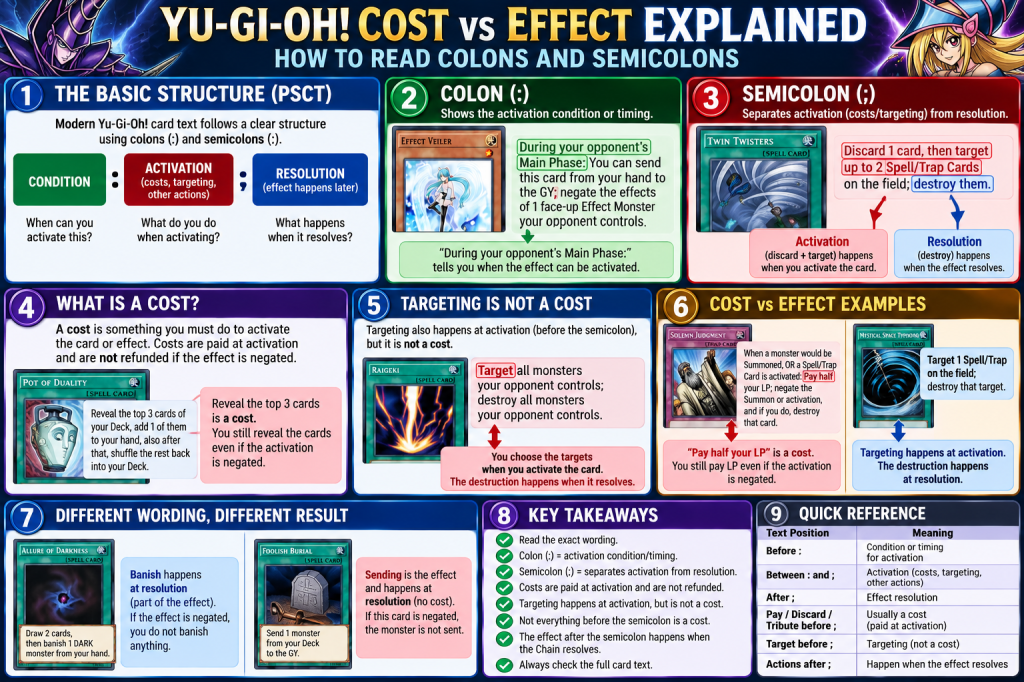
In Problem-Solving Card Text (PSCT), colons (:) and semicolons (;) separate different parts of an activated effect. Konami summarizes the basic structure as:
CONDITIONS : ACTIVATION ; RESOLUTION Yu-Gi-Oh! Card Database
Once you understand that structure, many seemingly complicated rulings become much easier to analyze.
1. What Is Problem-Solving Card Text?
Problem-Solving Card Text, usually abbreviated PSCT, is the standardized wording system used on modern Yu-Gi-Oh! cards.
It helps communicate information such as:
- when an effect can be activated,
- what you do when activating it,
- whether something is targeted,
- what is paid or performed as a cost,
- and what actually happens when the effect resolves.
Konami’s PSCT articles explain that punctuation is deliberately used to separate these parts of an effect. Yu-Gi-Oh! Card Database
The basic structure to remember is:
CONDITION : ACTIVATION ; EFFECT
Or, more precisely:
CONDITION : ACTIVATION ; RESOLUTION
Not every effect contains all three sections.
2. What Does a Colon (:) Mean?
A colon separates the activation condition or timing from what follows.
For example:
When this card is Normal Summoned: You can Special Summon 1 monster from your hand.
The part before the colon tells you when the effect can be activated:
When this card is Normal Summoned
The part after the colon describes what the effect does.
Konami explains that text before the colon identifies conditions for activation or limits when or how often the effect can be activated. Yu-Gi-Oh! Card Database
A useful way to visualize it is:
WHEN/IF THIS HAPPENS : DO THIS
3. What Does a Semicolon (;) Mean?
The semicolon is one of the most important pieces of punctuation in Yu-Gi-Oh!.
It separates:
what you do when activating the effect
from:
what happens when the effect resolves.
For example:
Discard 1 card, then target 1 card on the field; destroy that target.
The structure is:
Discard + target ; destroy
Everything before the semicolon happens during activation.
Everything after the semicolon happens during resolution.
Konami explicitly describes PSCT this way: activation text appears before the semicolon, while the actual resolving effect appears afterward. Yu-Gi-Oh! Card Database
4. The Basic PSCT Formula
The easiest way to read many activated effects is:
| Position | Meaning |
|---|---|
Before : | Activation condition/timing |
Between : and ; | Actions performed at activation |
After ; | Effect resolution |
So:
Condition : Activation ; Resolution
can be mentally translated as:
When can I activate this? → What do I do immediately? → What happens when it resolves?
This simple formula answers a large number of ruling questions.
5. What Is a Cost?
A cost is something you are required to do in order to activate a card or effect.
The official rulebook gives common examples including:
discarding cards, paying LP, banishing cards, and Tributing.
The rulebook also makes an extremely important point: a paid cost is not refunded merely because the activation is later negated. Yu-Gi-Oh! Card Database
For example, imagine an effect that says:
Pay 1000 LP; destroy 1 card on the field.
You pay the 1000 LP when you activate the effect.
Your opponent then responds and negates the activation.
You do not get the 1000 LP back.
The cost has already been paid.
6. Costs Appear Before the Semicolon
For modern PSCT, the semicolon gives you a powerful clue.
Konami explains that if the activation text before the semicolon tells you to pay, discard, Tribute, or destroy, that action is a cost. Costs are paid when the effect is activated. Yu-Gi-Oh! Card Database
For example:
Tribute 1 monster; destroy 1 card on the field.
The structure is:
Tribute 1 monster ; destroy 1 card
Therefore:
Tribute → happens at activation as the cost.
Destroy → happens when the effect resolves.
This distinction becomes crucial when another card is Chained.
7. Example: Discarding as Cost
Consider this hypothetical effect:
Discard 1 card; draw 2 cards.
When you activate it:
Step 1: Discard 1 card.
Your opponent now has an opportunity to respond.
Suppose your opponent negates the effect.
You do not draw 2 cards.
But the discarded card remains discarded.
Why?
Because the discard occurred as part of activating the effect.
The resolving effect was negated, but that does not reverse something already paid as a cost.
This follows the official rulebook’s principle that paid costs are not refunded when an activation is negated. Yu-Gi-Oh! Card Database
8. Cost and Effect Can Look Very Similar
This is where many players become confused.
Compare:
Discard 1 card; destroy 1 monster.
with:
Discard 1 card, then destroy 1 monster.
These sentences may sound similar in ordinary English.
In PSCT, however, their structure can be fundamentally different.
Version A
Discard 1 card; destroy 1 monster.
The discard occurs during activation.
The destruction occurs during resolution.
Version B
Discard 1 card, then destroy 1 monster.
If both instructions are part of the resolving effect, the discard happens during resolution, followed by the destruction according to the conjunction used.
This is why punctuation matters.
Do not assume that every discard, Tribute, banish, or LP payment you see is automatically a cost.
Its position in the card text matters.
9. Targeting Also Happens at Activation
The text before the semicolon does not contain only costs.
It also contains other actions performed during activation, most notably targeting.
For example:
Target 1 face-up monster your opponent controls; destroy that target.
When the card is activated:
the target is chosen immediately.
The destruction does not happen yet.
The opponent can then respond.
Only when the Chain resolves does the effect attempt to destroy the targeted monster.
Konami’s PSCT explanation explicitly places targeting in the activation portion of an effect. Yu-Gi-Oh! Card Database
Therefore:
Everything before
;is done at activation
does not mean:
Everything before
;is a cost.
That distinction is essential.
10. Cost vs Targeting
Suppose an effect says:
Discard 1 card, then target 1 monster your opponent controls; destroy it.
At activation you may have:
Discard 1 card → cost
Target 1 monster → targeting/action performed at activation
Then:
Destroy it → resolving effect
So the semicolon divides activation from resolution, not simply cost from effect.
This is one of the most useful corrections to the common beginner shortcut that “everything before the semicolon is cost.”
It isn’t.
Everything before the semicolon is activation text.
Some of that activation text may be the cost.
11. What Happens When an Effect Is Negated?
Suppose you activate:
Pay 1000 LP; destroy 1 card on the field.
You pay:
1000 LP
Your opponent Chains an effect that negates yours.
The Chain resolves.
Your destruction effect is negated.
Result:
1000 LP paid → stays paid
Destroy card → does not happen
The official rulebook specifically states that you do not receive a refund for a cost you paid even if the card’s activation is negated. Yu-Gi-Oh! Card Database
This gives us a useful general principle:
Negating an effect does not rewind the Duel to before its cost was paid.
12. Can You Pay a Cost If You Cannot Actually Pay It?
No.
A cost is required to activate the card or effect.
If you cannot pay the required cost, you generally cannot activate that card or effect.
For example, if an effect requires:
Pay 2000 LP;
you need to be able to pay the required amount under the applicable rules before activating it.
Likewise, if activation requires Tributing a particular type of monster and you cannot perform that Tribute, you cannot simply activate the effect and hope to satisfy the requirement later.
The cost belongs to activation, not resolution. Yu-Gi-Oh! Card Database
13. Conditions Are Different From Costs
Now consider:
If you control a Spellcaster monster: Target 1 monster; destroy that target.
The text before the colon:
If you control a Spellcaster monster
is an activation condition.
You need to satisfy it when activating the effect.
It is not a cost.
Konami explains that activation conditions appearing before the colon generally need to be satisfied when the card or effect is activated. If they stop being true before resolution, that alone does not necessarily stop the effect unless the text separately requires the condition to remain true. Yu-Gi-Oh! Card Database
So we now have three different concepts:
Condition → determines whether/when you can activate.
Activation procedure → costs, targeting and other actions performed when activating.
Resolution → what the effect actually does.
14. A Complete Example
Consider the hypothetical effect:
If you control a Dragon monster: Discard 1 card, then target 1 card your opponent controls; destroy that target.
Break it into three parts.
CONDITION
If you control a Dragon monster:
This tells you when the effect can be activated.
ACTIVATION
Discard 1 card, then target 1 card your opponent controls;
These actions occur when the effect is activated.
The discard is the cost in this example, while selecting the target is the targeting procedure.
RESOLUTION
destroy that target.
This happens when the effect resolves.
So visually:
CONTROL DRAGON : DISCARD + TARGET ; DESTROY
That is PSCT doing much of the ruling analysis for you.
15. Chains Make the Difference Easier to See
Imagine:
Chain Link 1: You activate an effect.
You immediately perform everything required at activation before the semicolon.
Your opponent responds.
Chain Link 2: Opponent activates another effect.
Both players eventually stop adding effects.
The Chain resolves backwards.
So the basic sequence is:
Activate CL1 → pay cost / choose targets
↓
Opponent activates CL2 → pay cost / choose targets
↓
CL2 resolves
↓
CL1 resolves
Konami uses this same activation-versus-resolution structure when explaining how PSCT interacts with Chains. Yu-Gi-Oh! Card Database
This is why costs cannot simply wait until resolution.
They have already happened before the opponent even decided whether to Chain something.
16. Colon or Semicolon Can Also Tell You That an Effect Starts a Chain
PSCT punctuation provides another valuable clue for monster effects.
Konami explains that if a monster effect contains a colon or semicolon, that indicates an effect that starts a Chain. Yu-Gi-Oh! Card Database
For example:
If this card is Summoned: You can draw 1 card.
The colon indicates an activated effect.
Compare that with a Summoning procedure such as the classic wording on Cyber Dragon, which does not contain a colon or semicolon.
That Special Summon itself does not start a Chain. Yu-Gi-Oh! Card Database
There is an important qualification for Spell and Trap Cards: activating a Spell or Trap Card starts a Chain even if its text contains no colon or semicolon. Yu-Gi-Oh! Card Database
17. No Semicolon Does Not Mean “No Effect”
Consider:
When this card is destroyed: Draw 1 card.
There is a colon but no semicolon.
That means there is a condition/timing component:
When this card is destroyed:
but there is no separate activation procedure between a colon and semicolon.
The resolving effect is simply:
Draw 1 card.
Likewise, some effects contain a semicolon without needing a separate condition before a colon.
Not every effect needs to contain the full:
A : B ; C
structure.
18. Why “Sent as Cost” and “Sent by Effect” Are Different
This distinction can have major consequences.
Suppose Card A activates by:
Send 1 monster from your hand to the GY; …
The monster is sent while Card A is being activated.
Compare that with:
…send 1 monster from your hand to the GY.
where the sending occurs as part of the resolving effect.
In the second situation, the monster is being sent by the effect.
In the first, it is being sent as part of the activation procedure/cost, assuming the wording establishes it as a cost.
That distinction matters whenever another card asks questions such as:
Was this card sent to the GY by a card effect?
Was this card discarded by an effect?
Was this monster Tributed by an effect?
Simply arriving in the same location does not mean the game treats the reason it got there identically.
19. Destroying a Card Is Not Automatically a Cost Either
Players sometimes memorize:
“Pay, discard, Tribute, banish, destroy = cost.”
That is not a safe rule.
Those actions can be costs.
But they can also be effects.
Konami’s guidance is more precise: if an instruction such as paying, discarding, Tributing or destroying appears in the activation text before the semicolon as something required to activate the effect, it is a cost. Yu-Gi-Oh! Card Database
Always determine where and how the action appears in the card text.
20. A Practical PSCT Checklist
When you encounter an unfamiliar effect, read it in this order:
1. Find the colon (:).
Everything before it generally tells you the condition/timing for activation.
2. Find the semicolon (;).
Everything before it but after the condition is performed during activation.
3. Identify the actual cost.
Do not assume every action before the semicolon is a cost. Targeting, for example, also occurs there.
4. Look after the semicolon.
That is the part that happens during resolution.
5. Ask what has already happened before the opponent responds.
Costs have already been paid and targets have already been selected.
6. Resolve the Chain backwards.
Only then do the resolving portions of the effects occur.
21. Common Misconceptions
“Everything before the semicolon is a cost.”
Incorrect.
Everything before the semicolon is part of the activation procedure. That can include costs and targeting. Yu-Gi-Oh! Card Database
“If my effect is negated, I get my cost back.”
Incorrect.
The official rulebook explicitly states that paid costs are not refunded when the activation is negated. Yu-Gi-Oh! Card Database
“Discarding is always a cost.”
Incorrect.
A discard can occur as a cost or as part of an effect. The card text determines which.
“Tributing is always a cost.”
Incorrect.
Again, look at the card text and where the action occurs.
“The colon separates the cost from the effect.”
Incorrect.
The colon primarily separates the activation condition/timing from what follows. The semicolon separates activation actions from resolution. Yu-Gi-Oh! Card Database
“No colon or semicolon means nothing starts a Chain.”
That shortcut works for identifying many monster effects and Summoning procedures, but remember that activating a Spell or Trap Card itself starts a Chain, even when its text has neither punctuation mark. Yu-Gi-Oh! Card Database
22. Quick Reference
| Card Text | Meaning |
|---|---|
| Condition : | Condition/timing for activation |
| : Activation ; | Actions performed when activating |
| ; Resolution | What happens when the effect resolves |
Discard before ; as required payment | Cost |
Pay LP before ; as required payment | Cost |
Tribute before ; as required payment | Cost |
Target before ; | Target selected at activation, but targeting itself is not a cost |
Instruction after ; | Resolving effect |
The most useful formula to memorize is therefore:
CONDITION : ACTIVATION ; RESOLUTION
Not:
CONDITION : COST ; EFFECT
The second version is tempting, but it is incomplete because activation text contains more than costs.
23. Conclusion
Colons and semicolons are among the most useful tools for understanding modern Yu-Gi-Oh! card text.
A colon (:) helps separate the conditions or timing for activating an effect.
A semicolon (;) separates what happens when you activate the effect from what happens when the effect resolves.
That gives us the basic PSCT structure:
CONDITION : ACTIVATION ; RESOLUTION
Costs are paid during activation and are not refunded simply because the activation is later negated. Targeting also normally occurs during activation, but targeting is not itself a cost. Yu-Gi-Oh! Card Database
Once you learn to identify these three sections, questions such as “Was that discarded for cost?”, “When do I choose the target?”, “Does my opponent respond before or after I Tribute?”, and “Do I get my LP back if the effect is negated?” become considerably easier to answer directly from the card text.
For Duelpedia, this is an especially useful cornerstone topic because many individual rulings can eventually link back to the same fundamental principle:
Read what happens before the colon, before the semicolon, and after the semicolon.
Official Sources
Konami — Problem-Solving Card Text, Part 3: Conditions, Activations, and Effects
Konami — Problem-Solving Card Text, Part 4: The Clues on Your Cards
Konami — Official Yu-Gi-Oh! TCG Rulebook & Beginner’s Guide


Leave a Reply