Authority: Duelpedia
Official ruling confirmed: unknown
Source: Duelpedia
Link: https://duelpedia.com/2026/09/28/yu-gi-oh-targeting-explained-target-vs-non-targeting-effects/
Format: TCG
Status: resolved
Date: 28 September 2026
Targeting is one of the most important concepts to understand in Yu-Gi-Oh! TCG rulings.
A monster might say that it “cannot be targeted by card effects.” But that does not necessarily mean it cannot be affected by your opponent’s cards.
The reason is simple:
Not every effect that affects a specific card targets that card.
Modern Yu-Gi-Oh! card text uses Problem-Solving Card Text (PSCT) to indicate whether an activated effect targets. Learning how to recognize this wording makes many interactions considerably easier to understand.
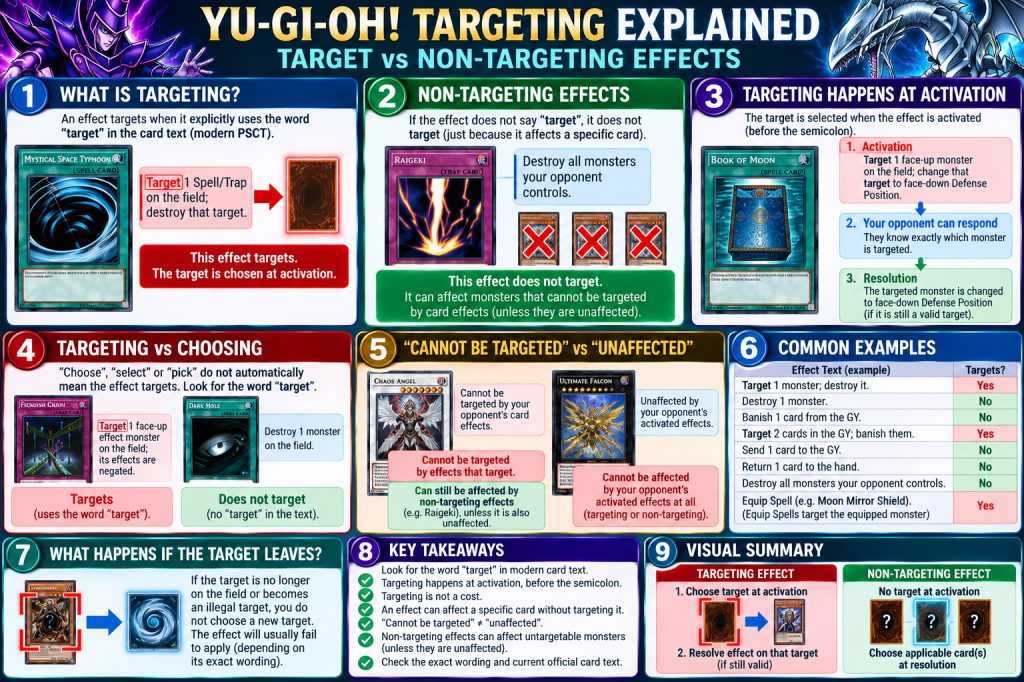
1. What Does “Target” Mean in Yu-Gi-Oh!?
In everyday language, players might say:
“I’m using this effect on your monster.”
That does not necessarily mean the effect targets the monster according to the rules.
In Yu-Gi-Oh!, targeting is a specific game mechanic.
For modern card text, an activated effect that targets will normally explicitly use the word:
target
For example:
Target 1 monster your opponent controls; destroy that target.
The monster is selected when the effect is activated.
The destruction happens later when the effect resolves.
Konami’s Problem-Solving Card Text guidance explains that targeting requirements are included in the activation portion of an effect. Konami — Problem-Solving Card Text, Part 3
2. The Most Important Rule: Look for the Word “Target”
For modern PSCT, the easiest starting point is:
If the effect says “target,” it targets.
If the effect does not say “target,” you should not assume that it targets merely because you have to interact with a particular card.
Compare these hypothetical effects:
Target 1 monster your opponent controls; destroy it.
and:
Destroy 1 monster your opponent controls.
The first effect explicitly targets.
The second does not say target.
That difference can completely change how the cards interact with monsters that cannot be targeted by card effects.
3. Targeting Happens at Activation
Consider:
Target 1 face-up monster your opponent controls; destroy that target.
This can be separated using the PSCT structure discussed in our Cost vs Effect guide:
Target 1 face-up monster your opponent controls ; destroy that target
Everything before the semicolon is performed when the effect is activated.
Everything after the semicolon happens when the effect resolves.
Therefore:
Activation: Choose the target.
Response window: Your opponent can activate another card or effect.
Resolution: Attempt to destroy the selected target.
The target is not selected when the Chain resolves. It was already selected when the effect was activated.
4. Targeting Is Not a Cost
This distinction is particularly important.
Suppose an effect says:
Discard 1 card, then target 1 monster your opponent controls; destroy that target.
Both the discard and targeting occur during activation.
But that does not mean both are costs.
The structure is:
Discard → cost
Target → targeting procedure performed at activation
Destroy → resolving effect
This is why the shortcut:
“Everything before the semicolon is a cost.”
is incorrect.
The text before the semicolon describes things performed during activation, which can include costs, targeting and other activation procedures.
5. What Is a Non-Targeting Effect?
Players commonly use “non-targeting” to describe an effect that affects cards without targeting them.
For example, consider a hypothetical effect:
Destroy 1 monster your opponent controls.
If this effect does not target, the card to be destroyed is not selected as a target when the effect is activated.
Instead, the relevant choice may be made when the effect resolves.
That distinction matters because the game does not treat:
Target 1 monster; destroy it.
the same as:
Destroy 1 monster.
Even though both effects may ultimately destroy one monster.
The method by which they affect that monster is different.
6. Targeting vs Choosing at Resolution
Consider these two effects.
Effect A
Target 1 card your opponent controls; banish it.
At activation:
You select the target.
Your opponent therefore knows exactly which card the effect intends to banish before deciding whether to respond.
Effect B
Banish 1 card your opponent controls.
If the effect does not target and the applicable card is selected during resolution, your opponent must decide whether to respond before knowing which eligible card will ultimately be chosen.
That creates a significant practical difference.
| Targeting Effect | Non-Targeting Effect |
|---|---|
| Target identified at activation | No target designated at activation |
| Opponent knows the target before responding | Relevant selection may occur during resolution |
| Must satisfy targeting requirements | Does not target |
| “Cannot be targeted” protection can matter | “Cannot be targeted” does not by itself stop it |
7. “Choose” Does Not Automatically Mean “Target”
A common mistake is treating ordinary English words as interchangeable with the game term target.
Words such as:
choose
select
pick
or simply referring to a card
do not automatically make an effect a targeting effect.
With modern PSCT, you should primarily look for the actual word “target.”
This is important because Yu-Gi-Oh! card text is not merely conversational English. Specific words can carry specific mechanical meanings.
8. “Cannot Be Targeted” Does Not Mean “Unaffected”
Suppose a monster says:
Cannot be targeted by your opponent’s card effects.
That protection prevents your opponent from targeting it with effects that actually target.
It does not automatically make the monster immune to every card effect.
For example, an effect that destroys all monsters:
Destroy all monsters your opponent controls.
does not need to target each monster individually merely because those monsters will be destroyed.
Likewise, a non-targeting effect that affects a card can potentially affect a monster protected only from targeting, provided no other protection applies.
This leads to an important distinction:
Cannot be targeted ≠ unaffected by card effects.
These are different forms of protection.
9. Targeting and Destruction Are Separate Concepts
Another common misconception is:
“If it destroys one monster, it must target that monster.”
That is not how targeting is determined.
Destruction tells you what happens to the card.
Targeting tells you how the effect designates a card as part of its activation.
Therefore, you can have:
Targeting destruction
Target 1 card; destroy it.
and:
Non-targeting destruction
Destroy 1 card.
The fact that both ultimately destroy a card does not make their activation procedures identical.
10. Banish, Return and Send Do Not Automatically Target Either
The same principle applies to other actions.
An effect does not target simply because it:
- destroys,
- banishes,
- sends to the GY,
- returns to the hand,
- returns to the Deck,
- changes control,
- or negates another card.
You need to read the actual card text.
For example:
Target 1 card in either GY; banish it.
targets.
But wording such as:
Banish 1 card from either GY.
does not automatically become targeting merely because one card ultimately gets banished.
The action itself does not determine whether an effect targets.
The card text and effect mechanics do.
11. What Happens If the Target Disappears?
Suppose you activate:
Target 1 monster your opponent controls; destroy that target.
Your opponent Chains another effect that removes the targeted monster from the field.
The Chain then resolves backwards.
The opponent’s effect resolves first and removes the monster.
Your effect then attempts to resolve.
The original target is no longer where the effect expects it to be.
What happens next depends on the precise card text and effect involved.
The important point is:
You do not simply choose a new target.
The target was already selected during activation.
Resolution does not normally give you another opportunity to replace it with a different target.
12. What If the Target Becomes Illegal?
A similar situation occurs when the targeted card remains present but stops satisfying the effect’s requirements.
Imagine an effect that says:
Target 1 face-up Level 4 or lower monster your opponent controls; destroy that target.
The monster qualifies when the effect is activated.
Another effect is Chained that changes the monster so that it no longer satisfies the relevant targeting requirement.
Whether the original effect can still apply depends on its exact wording and the requirements it imposes at resolution.
This is why phrases such as:
“that target”
and:
“it”
can matter when interpreting PSCT.
The safest approach is always to examine the complete text rather than applying a universal rule that every change to a target causes the same result.
13. Targeting Multiple Cards
Effects can also target more than one card.
For example:
Target 2 Spell/Trap Cards on the field; destroy them.
Both targets are selected during activation.
If one target disappears before resolution, you should not automatically assume either:
the entire effect fails
or:
the remaining card is always affected.
The result depends on the exact effect wording and how its resolution requirements work.
Again, PSCT matters.
Yu-Gi-Oh! rulings often turn on seemingly small wording differences.
14. Equip Spells Normally Target
There is an important exception to the simple “look for the word target” shortcut.
The official rulebook explains that when you activate an Equip Spell Card, you choose a face-up monster to equip it to, and Equip Spell Cards target the equipped monster. Official Yu-Gi-Oh! TCG Rulebook
This is a useful reminder that the rules of particular card types can also establish targeting behavior.
So:
“It doesn’t literally say target.”
should not be treated as an absolute rule covering every possible card and mechanic.
15. Older Card Text Requires Extra Care
The “look for the word target” method is most reliable when dealing with cards using modern PSCT.
Older printings can be more difficult.
Yu-Gi-Oh! existed for years before modern Problem-Solving Card Text standardized many of these distinctions.
As a result, an old printing might use wording that does not communicate targeting as clearly as a modern printing.
When dealing with an older card, check its current official card text rather than relying exclusively on the wording printed on an old physical copy.
Official Yu-Gi-Oh! Neuron Card Database
16. Targeting vs Cost vs Effect
These concepts are easy to mix together, so consider this hypothetical effect:
If you control a Dragon monster: Discard 1 card, then target 1 face-up monster your opponent controls; destroy that target.
We can divide it into four concepts.
Condition
If you control a Dragon monster:
This establishes when the effect can be activated.
Cost
Discard 1 card
The cost is paid during activation.
Targeting
target 1 face-up monster your opponent controls
The target is also selected during activation.
Effect
destroy that target.
The destruction occurs during resolution.
This gives us:
CONDITION : COST + TARGET ; EFFECT
But remember that this is an explanatory shortcut.
The broader PSCT structure remains:
CONDITION : ACTIVATION ; RESOLUTION
17. Why This Matters for Chains
Targeting becomes much easier to understand when viewed through Chain resolution.
Imagine:
Chain Link 1
You activate:
Target 1 monster your opponent controls; destroy it.
You select Monster A immediately.
Your opponent now knows Monster A is the target.
They respond:
Chain Link 2
An effect removes Monster A from the field.
The Chain resolves backwards:
CL2 resolves → Monster A leaves.
CL1 resolves → the original effect attempts to resolve using its original target.
You cannot simply say:
“Then I’ll destroy Monster B instead.”
Monster B was never targeted.
This illustrates why selecting something at activation is mechanically different from making a choice during resolution.
18. Targeting Protection vs Destruction Protection
These protections should also not be confused.
Protection A
Cannot be targeted by card effects.
This protects against effects that target the monster.
It does not inherently stop non-targeting effects.
Protection B
Cannot be destroyed by card effects.
This protects against destruction by card effects.
A targeting effect could still target the monster if nothing else prevents that targeting; the destruction protection concerns what the effect can ultimately do.
A monster can therefore be:
targetable but indestructible
or:
untargetable but destructible by a non-targeting effect.
These protections answer different questions.
19. Targeting Protection vs Being Unaffected
Now compare:
Cannot be targeted by your opponent’s card effects.
with:
Unaffected by your opponent’s activated effects.
These are fundamentally different restrictions.
The first asks:
Does this effect target the monster?
The second asks:
Can this effect affect the monster at all under that protection?
A non-targeting effect can bypass targeting protection, but that does not mean it automatically bypasses a monster that is unaffected by that effect.
This distinction is essential when analyzing boss monsters with multiple layers of protection.
20. Common Misconceptions
“If I choose a monster, I’m targeting it.”
Not necessarily.
Targeting is a specific game mechanic, not simply the ordinary act of choosing something.
“If an effect affects one card, it targets.”
No.
Effects can affect individual cards without targeting them.
“If a card cannot be targeted, it cannot be destroyed by effects.”
No.
A non-targeting destruction effect may still be able to destroy it unless another protection prevents that destruction.
“All destruction effects target.”
No.
Targeting and destruction are separate concepts.
“Everything before the semicolon is a cost.”
No.
Targeting normally occurs during activation as well, but targeting itself is not a cost.
“If my target disappears, I can choose another target.”
Normally, no.
The target was selected when the effect was activated.
“If the word ‘target’ isn’t there, the effect never targets.”
For modern PSCT activated effects, that is an extremely useful rule of thumb, but card-type rules and older text mean it should not be treated as an absolute statement covering every situation.
21. Quick Reference
| Card Text / Situation | Targets? |
|---|---|
| “Target 1 monster; destroy it.” | Yes |
| “Target 1 card in the GY; banish it.” | Yes |
| “Destroy all monsters your opponent controls.” | No individual targeting |
| “Destroy 1 monster your opponent controls.” | Not merely because one monster is affected |
| “Banish 1 card…” | Not automatically |
| “Send 1 card…” | Not automatically |
| Equip Spell selecting its monster | Yes |
| Card says “cannot be targeted” | Protects against targeting effects, not every effect |
The simplest question to ask is:
Does the effect actually target according to its text and the rules?
Do not determine targeting merely by asking:
Does this effect affect a specific card?
Those are different questions.
22. Practical Targeting Checklist
When you encounter an unfamiliar card, check:
1. Does the current card text explicitly say “target”?
If yes, you have strong evidence that the activated effect targets.
2. When is the card selected?
Targets are designated during activation.
3. Is something being selected during resolution instead?
That may indicate the effect is not targeting.
4. Is this an Equip Spell or another mechanic with specific targeting rules?
Check the relevant game rule.
5. Does the monster say “cannot be targeted”?
Determine whether the incoming effect actually targets before applying that protection.
6. Does the monster instead say “unaffected” or “cannot be destroyed”?
Those are different protections and require different analysis.
7. Are you reading an old printing?
Check the current official card text.
23. Conclusion
The most important lesson is:
A card is not targeted simply because an effect affects it.
With modern Problem-Solving Card Text, targeting is normally made explicit through the word “target.”
Targeting generally occurs when an effect is activated, before the Chain resolves.
This gives us an important distinction:
Targeting effect: selects its target during activation.
versus:
Non-targeting effect: does not designate a target as part of its activation.
That distinction explains why a monster that cannot be targeted by card effects can still potentially be affected by a non-targeting destruction, banishing, sending or other effect.
It also explains why a target cannot normally be replaced simply because the original card disappears before resolution.
For ruling questions, avoid asking only:
“Which card does this effect affect?”
Instead ask:
“Does the card text or game mechanic actually target it?”
That small change in approach resolves a surprisingly large number of Yu-Gi-Oh! interactions.
Official Sources
Konami — Problem-Solving Card Text, Part 3: Conditions, Activations, and Effects
Official Yu-Gi-Oh! TCG Rulebook
Official Yu-Gi-Oh! Neuron Card Database


Leave a Reply