
Authority: Duelpedia
Official ruling confirmed: unknown
Source: Duelpedia
Link: https://duelpedia.com/2026/09/30/yu-gi-oh-negation-explained-negate-activation-vs-negate-effect/
Format: TCG
Status: resolved
Date: 30 September 2026
Negation is one of the most important—and most frequently misunderstood—mechanics in Yu-Gi-Oh!.
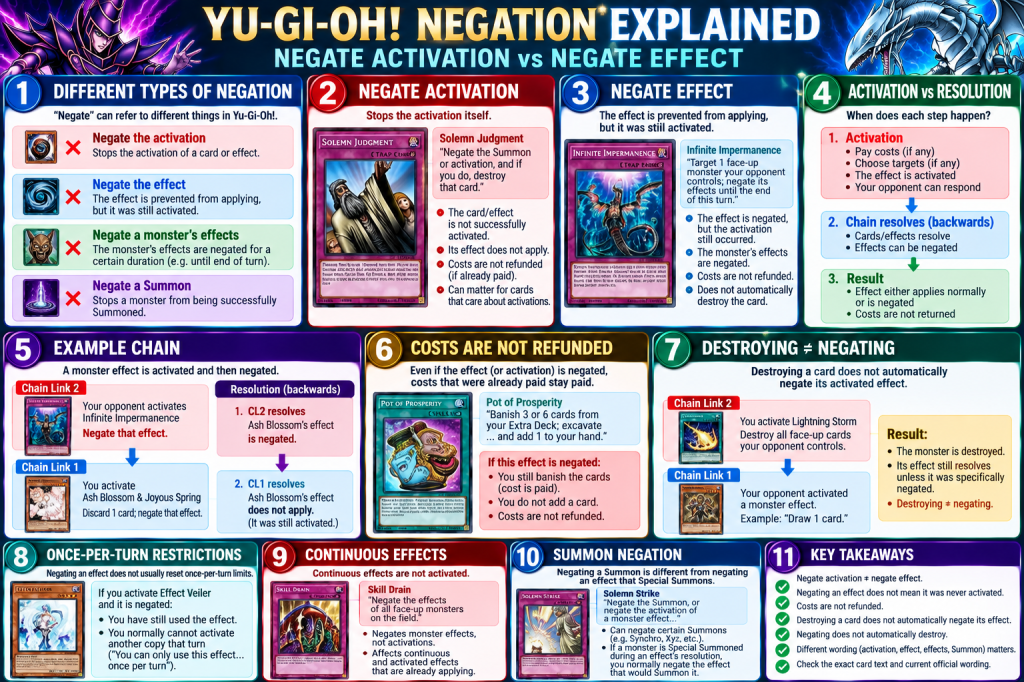
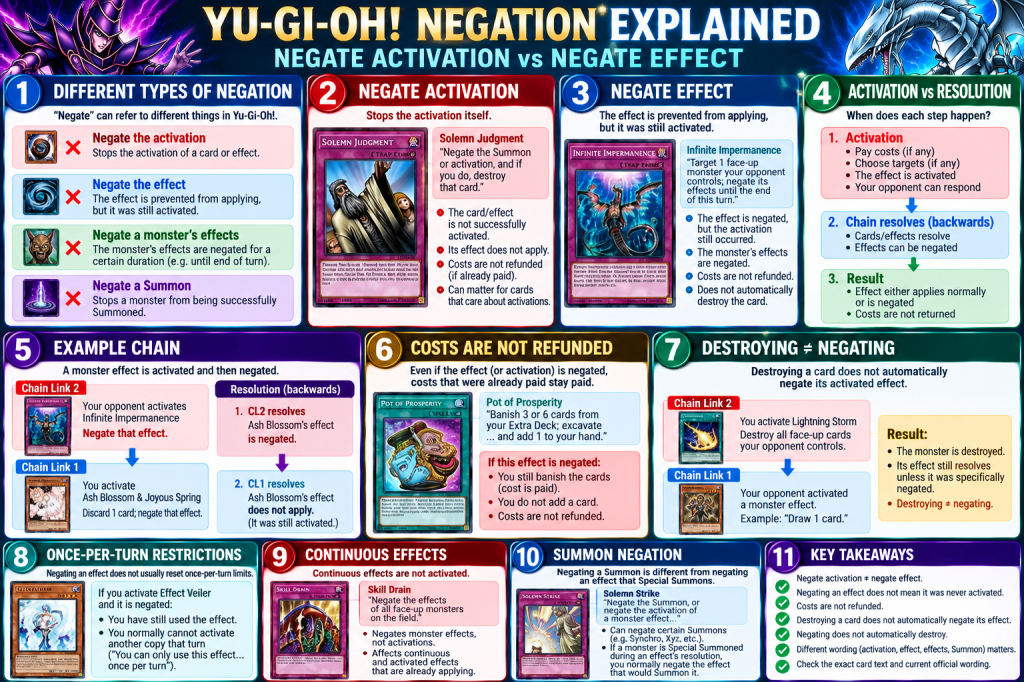
Cards can negate an activation, negate an effect, negate a monster’s effects, or even negate a Summon. These phrases may sound similar, but they do not describe exactly the same thing.
Consider two familiar types of card text:
Negate the activation…
and:
Negate its effects…
Both stop something, but they interact with the game differently.
Understanding the distinction is especially important for Chains, costs, once-per-turn restrictions, Continuous effects, and cards that care whether another card or effect was successfully activated.
1. What Does Negation Mean?
At its most basic level, negation prevents something that would otherwise happen from applying normally.
But the first question should always be:
What exactly is being negated?
Yu-Gi-Oh! cards can negate different things:
- the activation of a card,
- the activation of an effect,
- an effect itself,
- the effects of a face-up card,
- or a Summon.
These are not interchangeable.
The exact wording of the negating card determines what it does.
2. Negating an Activation
Consider Solemn Judgment.
Its current text includes:
“negate the Summon or activation”
If a Spell/Trap Card is activated and Solemn Judgment is used successfully against that activation, the activation itself is negated. Yu-Gi-Oh! Database
Other cards use similar wording for monster effects.
For example, Solemn Strike can respond when a monster effect is activated and says to negate the activation. Yu-Gi-Oh! Database
The important phrase is:
negate the activation
The game is not merely allowing the activation to resolve with no effect. It is specifically negating that activation.
3. Negating an Effect
Now compare that with Infinite Impermanence.
Its text begins by targeting a face-up monster and then says:
“negate its effects”
It does not say that the activation of a monster’s effect is negated. Instead, the monster’s effects are negated for the specified duration. Yu-Gi-Oh! Database
This gives us the fundamental distinction:
| Negate Activation | Negate Effect |
|---|---|
| Stops the activation itself | Activation can still occur |
| Text specifically says “negate the activation” | Text says “negate the effect(s)” or similar |
| Often used by Counter Traps and other response effects | Common on cards such as Infinite Impermanence |
| Can matter for rules that specifically care about activation | Effect is prevented from applying normally |
Do not treat these phrases as interchangeable.
4. Activation and Resolution Are Different Events
This distinction becomes easier to understand when you remember how Chains work.
Suppose a monster activates:
If this card is Summoned: Draw 1 card.
That activation becomes Chain Link 1.
Your opponent responds with another effect as Chain Link 2.
The Chain then resolves backwards.
If Chain Link 2 says:
Negate that effect.
then the original effect was still activated.
Its effect is simply prevented from applying when its Chain Link resolves.
By contrast, if Chain Link 2 says:
Negate the activation.
then it is specifically negating the activation of Chain Link 1.
Konami’s PSCT documentation distinguishes what happens when a card or effect is activated from what happens when that card or effect resolves. Yu-Gi-Oh! Card
That distinction is the foundation for understanding negation.
5. Negating an Effect Does Not Mean It Was Never Activated
This is one of the most important concepts.
Imagine:
Chain Link 1: Monster Effect A activates.
Chain Link 2: An effect is activated that negates Monster A’s effect.
The Chain resolves:
CL2: Monster A’s effect becomes negated.
CL1: Monster A’s effect resolves negated.
The important point is that Monster A’s effect was still activated.
The fact that its effect was later negated does not erase the earlier activation from the game history.
This can matter when another effect or restriction asks whether something was activated during the turn.
6. Costs Are Not Refunded by Negation
Suppose a hypothetical monster says:
Discard 1 card; draw 2 cards.
The discard is a cost paid when the effect is activated.
You discard the card.
Your opponent then Chains something that negates the effect.
Result:
Discarded card: stays discarded.
Draw 2 cards: does not happen.
Why?
Because the cost was already paid during activation.
Negating the effect does not rewind the Duel to the moment before the cost was paid.
Konami’s PSCT system separates what happens during activation—including costs and targeting—from what happens when the effect resolves. Yu-Gi-Oh! Card
This connects directly with the broader principle explained in Duelpedia’s Cost vs Effect guide:
Negation does not normally refund an already-paid cost.
7. Negating the Activation Does Not Normally Refund the Cost Either
Now consider a stronger form of negation.
You activate:
Discard 1 card; draw 2 cards.
You discard the card as cost.
Your opponent responds:
Negate the activation.
You still do not get the discarded card back.
The cost was paid when you attempted the activation.
Negating that activation does not rewind the game state and return costs that have already been paid.
This is why players should think of the sequence as:
Pay cost → activate → opponent responds → Chain resolves
rather than:
Activate → resolve → pay cost
8. Negation and Once-Per-Turn Restrictions
Negation becomes especially important when a card has a once-per-turn restriction.
Suppose an effect says:
You can only use this effect of “[Card Name]” once per turn.
You activate the effect.
Your opponent negates it.
Can you simply activate another copy and try again?
Usually, a “you can only use” restriction has already been consumed because you used the effect.
Negating what the effect does does not normally erase the fact that you used it.
However, exact wording matters.
There is a meaningful difference between restrictions using words such as:
use
and:
activate
This is why once-per-turn questions should always be answered from the exact card text rather than from the abbreviation “HOPT” alone.
9. Negating an Effect Is Not the Same as Destroying the Card
Another extremely common misconception is:
“I destroyed the card, so its effect is negated.”
Usually, that is incorrect.
Suppose:
Chain Link 1: A monster activates its effect.
Chain Link 2: You activate an effect that destroys that monster.
The Chain resolves backwards.
The monster is destroyed.
Then its previously activated effect attempts to resolve.
Merely destroying the monster does not automatically negate its activated effect.
The card destroying it needs to actually say something that negates the effect if negation is required.
This gives us a very important rule of thumb:
Destroying ≠ negating.
10. Why Destroying a Spell or Trap Can Be Different
There is an important complication.
Some Spell and Trap effects require the card to remain face-up on the field in order to apply successfully.
This is particularly relevant to cards such as Continuous Spells, Continuous Traps, Field Spells, and certain other Spell/Trap types.
Therefore, destroying such a card before its effect resolves can sometimes prevent the effect from applying normally.
But that still does not mean:
destruction = negation.
The card was destroyed.
Its activation or effect was not necessarily negated.
That distinction can matter to other cards and game mechanics.
Always separate:
“The effect did not successfully apply.”
from:
“The effect was negated.”
They are not automatically the same statement.
11. Negating a Monster’s Effects
Cards such as Infinite Impermanence provide another form of negation.
Its text targets a face-up monster and negates its effects for the specified duration. Yu-Gi-Oh! Database
This is broader than simply responding to one particular activation with:
Negate that activation.
Instead, the monster itself is placed under an effect that negates its effects.
That can affect multiple aspects of the monster depending on the precise cards and circumstances.
This is why the phrases:
negate that effect
and:
negate its effects
should not automatically be treated as identical.
12. Activated Effects vs Continuous Effects
This distinction also matters when dealing with Continuous Effects.
Imagine a monster has a continuously applying effect while it remains face-up.
There may be no individual activation to negate.
A card that specifically responds:
When a monster effect is activated…
requires an activation.
It cannot simply respond to the existence of every Continuous Effect.
By contrast, an effect that says:
Negate the effects of that face-up monster.
can potentially negate effects applying from that monster even though those effects themselves are not being activated at that moment.
This is why identifying whether an effect activates is essential before deciding whether an activation-negation card can interact with it.
13. Negating a Card Activation vs Negating an Effect Activation
Spells and Traps introduce another useful distinction.
There is a difference between:
activating a Spell/Trap Card
and:
activating the effect of a Spell/Trap Card that is already present.
For example, placing and activating a Trap Card from the Spell & Trap Zone is a card activation.
But a Continuous Trap already face-up on the field may later have an activated effect.
That later activation is an effect activation, not another activation of the Trap Card itself.
Therefore, a card that specifically responds to:
a Spell/Trap Card being activated
may not necessarily respond to every later effect activation of an already face-up Spell or Trap.
Again:
card activation ≠ effect activation.
14. Negating a Summon Is Another Mechanic
Negating a Summon should also be distinguished from negating an effect that Special Summons.
Konami’s PSCT guidance specifically explains this difference.
Cards capable of negating a Summon can negate certain Summons that occur without an activated effect resolving—such as Synchro, Xyz, and certain built-in Special Summons.
But when a monster is being Special Summoned during the resolution of an activated card or effect, you generally do not interrupt the resolving Chain to negate the Summon itself with something that only negates Summons.
Instead, you would need an appropriate response to the card or effect that performs the Summon. Yu-Gi-Oh! Card
This produces three distinct ideas:
Negate the Summon
Negate the activation of the effect that would Summon
Negate the effect that would Summon
They can lead to similar outcomes, but they are mechanically different.
15. Example: Solemn Strike
Solemn Strike demonstrates this distinction particularly well.
Its official text can respond when:
- a monster would be Special Summoned, or
- a monster effect is activated.
Depending on which situation occurs, it can negate the Summon or the activation. Yu-Gi-Oh! Database
Those are two separate game events.
This is also why you cannot reduce Solemn Strike to simply:
“It negates monsters.”
Its actual wording tells you exactly what events it can interact with.
16. Example: Infinite Impermanence
Now compare that with Infinite Impermanence.
It targets a face-up monster and negates that monster’s effects until the end of the turn. Yu-Gi-Oh! Database
It does not say:
Negate the activation.
Therefore, if a monster effect has already been activated and Infinite Impermanence legally applies to that monster, the important distinction is:
the activation occurred, but the relevant effect can be negated.
That difference can matter for other cards that care about whether an effect was activated.
17. Example: Solemn Judgment
Solemn Judgment uses yet another form of negation.
Its official text allows it, under the appropriate circumstances, to:
negate the Summon or activation
and then destroy the card if the negation succeeds. Yu-Gi-Oh! Database
Notice that the text separately mentions:
negation
and:
destruction.
That itself demonstrates an important principle.
If destroying the card automatically meant negating it, there would be no need for card text to distinguish those actions.
18. Negation Does Not Automatically Destroy
The reverse is also true.
An effect can negate another card without destroying it.
Infinite Impermanence, for example, can negate a monster’s effects without destroying that monster. Yu-Gi-Oh! Database
Therefore:
Negate ≠ destroy
and:
Destroy ≠ negate
These are independent actions unless a card specifically performs both.
19. What About Cards That Leave the Field?
Suppose a monster activates an effect.
Then, before that effect resolves, the monster leaves the field.
Does its effect automatically become negated?
No.
An activated effect exists as a Chain Link separately from the physical card that activated it.
Unless the card text, another effect, or a specific rule requires otherwise, simply removing the source does not automatically negate its already-activated effect.
This is closely related to why destroying a monster in response to its effect normally does not stop that effect.
Again, you need to ask:
What actually negated the effect?
If the answer is merely:
“The monster isn’t there anymore,”
that is not by itself a universal negation rule.
20. Negation Does Not Rewind the Game
This principle ties several concepts together.
Suppose:
- You activate an effect.
- You pay its cost.
- You choose its target.
- Your opponent responds.
- Your effect is negated.
The game does not rewind to Step 1.
You do not automatically:
- recover the cost,
- undo earlier legal actions,
- erase the fact that an effect was used,
- or select a different target.
Negation affects whatever the card text says it negates.
It is not a universal undo button.
21. Quick Comparison
| Situation | Activation Occurred? | Effect Applies Normally? |
|---|---|---|
| Effect resolves normally | Yes | Yes |
| Effect is negated | Yes | No |
| Activation is negated | Activation itself is negated | No |
| Card is merely destroyed in response | Yes | Often still can |
| Monster’s effects are negated | Activations may still occur depending on the effect | Negated effects do not apply normally |
| Summon is negated | Separate Summon-negation mechanic | Monster is not successfully Summoned |
The exact interaction always depends on the cards involved.
22. Common Misconceptions
“Negate activation and negate effect mean the same thing.”
No.
The wording deliberately distinguishes them.
“If my effect is negated, it was never activated.”
No.
An effect can be activated and later have its effect negated.
“If my opponent destroys my monster, its effect is negated.”
Usually not.
Destroying a monster does not automatically negate an effect it already activated.
“If my activation is negated, I get my cost back.”
No.
Costs already paid are not simply refunded.
“Negating a card always destroys it.”
No.
Negation and destruction are separate mechanics.
“Destroying a card means its activation was negated.”
No.
A card can be destroyed without its activation being negated.
“If a monster’s effects are negated, it can never activate anything.”
Do not use this as a universal rule.
Whether an effect can be activated and whether its effect will successfully apply are separate questions that depend on the restriction and card text involved.
“Negating a Summon is the same as negating an effect that Special Summons.”
No.
Konami explicitly distinguishes a Summon itself from an activated card or effect that performs a Summon. Yu-Gi-Oh! Card
23. A Practical Negation Checklist
When you encounter a negation interaction, ask:
1. What exactly does the card say it negates?
Look for:
activation, effect, effects, or Summon.
2. Was a cost already paid?
If yes, negation does not normally refund it.
3. Was a target already selected?
Targeting normally happens at activation, before the Chain resolves.
4. Does the negating card destroy as well?
Do not assume negation automatically includes destruction.
5. Was the card merely removed from the field?
Removal does not automatically negate an already-activated effect.
6. Is this a card activation or an effect activation?
This distinction can matter for Spells and Traps.
7. Is the effect activated or Continuous?
A card that responds specifically to an activation requires something that actually activates.
8. Is this actually a Summon-negation question?
Determine whether the Summon occurs independently or during the resolution of an activated effect.
24. The Most Important Distinctions
When learning negation, remember these five statements:
Negating an activation is not the same as negating an effect.
Negating an effect does not mean it was never activated.
Negating does not automatically destroy.
Destroying does not automatically negate.
Negating does not rewind costs and other actions already performed during activation.
Those principles solve a surprisingly large number of Yu-Gi-Oh! ruling questions.
25. Conclusion
“Negate” is not one universal mechanic that makes everything associated with a card disappear.
You must determine what the card actually negates.
A card might negate:
an activation,
an effect,
a monster’s effects,
or:
a Summon.
Those distinctions matter.
If an effect is activated and its effect is later negated, the activation still occurred.
If the activation itself is negated, the game specifically treats that activation as negated.
Neither situation automatically refunds costs already paid.
Likewise, destroying or removing the card that activated an effect does not normally negate that effect merely because its source has disappeared.
The best habit is therefore to stop reading every form of negation as simply:
“That card doesn’t work.”
Instead, ask:
What exactly is being negated—the activation, the effect, the card’s effects, or the Summon?
Once that question becomes automatic, many complicated-looking interactions become much easier to analyze.
Official Sources
Konami — Problem-Solving Card Text
Konami — PSCT Part 3: Conditions, Activations, and Effects
Konami — PSCT Part 5: Special Summons and Summon Negation


Leave a Reply